Bookstore Creep: The Actual Star & The Savage Detectives
This column is written by a partial-earth creature and may be perplexing without context. Check out the previous columns in the Bookstore Creep series:
I - Love After the End, from Belmont Books
II - Hikuri, from Mother Foucault
III - Alien Daughters Step into the Sun, from Word Virus Books
V - Chain-Gang All-Stars, from Parallel Worlds Bookshop
VI - Paul Takes the Form of a Mortal Girl, from Wallace Books
VII - Mona, from Powell’s Books
VIII - Free Sublimation for your Reading Pleasure
The beginning of the end and entropy of Bookstore Creep the column.
I have been pouring over used copies of Spanish grammar textbooks in my spare time these last two years, attempting to learn the entire language to a level of fluency so that I, Rosalie L.H. Caggiano, could read fiction from Mexico in its mother tongue…. I gave up on this absurd side-quest about two months ago. Fluency is as fluid as it sounds, and my efforts were only building a robotic structure of creaky, windy knowledge within me that did not aid in understanding such a rich organic form as a novel in the Spanish language. It had been too long since I had first discovered Infrarealism and since my friend told me that I need to read The Savage Detectives. It was meant to be a side-project, as the novel was published in 1998, out of the span of my central research question for this scientific investigation into modern books that speak to the artistic underground of the last twenty years. Ultimately, I yielded to the longing, the curiosity. I abandoned the rigid structure that I had created myself only for fun and evolution, anyways.
I will be honest, this column has been degrading for a long time. I do not think that is wrong, I think it is amusing. It is clear in my day to day. I began as a partial-earth-creature and I am still quite strange but I am essentially fully formed and passing as human. I have friends, I have urges, I write, I read, I play. I am developing disorders and passions and allergies and all sorts of human traits. With all of these new characteristics, I feel confident in saying that disorder is relieving. Disorder is the natural outcome of an artist attempting to follow western scientific methods, it is fracaso. I learned some things in my Spanish studies, such as the fact that the word for failure sounds much better in Spanish. My project has become a fracaso. A case of friendly chaos.
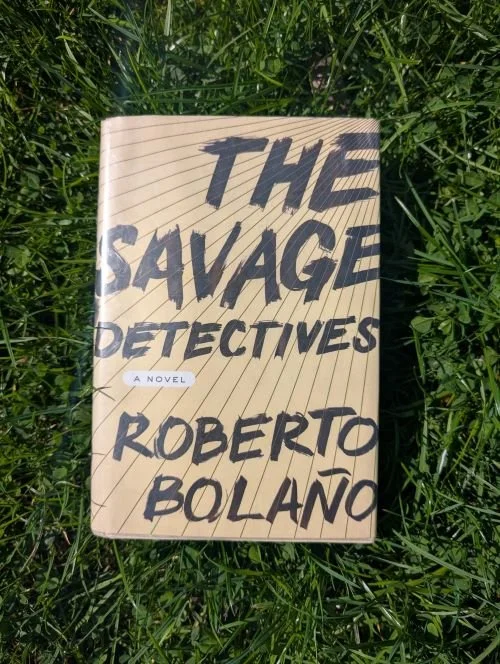
In the process of reading The Savage Detectives by Roberto Bolaño, I missed many deadlines. Then I quit my job (I had picked up a job, having become more human and more hungry and with higher dopamine needs) and bought a plane ticket to Mexico. Not to continue the column, but rather to end the column with integrity in a slightly less expensive setting, to learn Spanish the human way, and primarily porque México me llama mi atención. Because she was calling me.
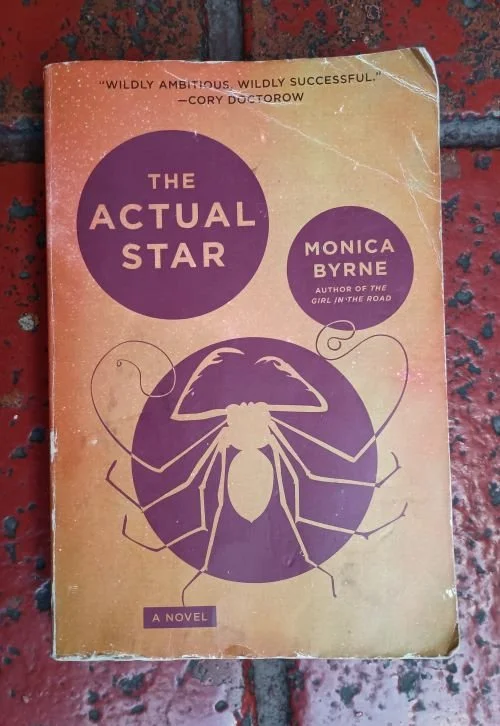
In the process of leaving the United States of… a friend slipped a book into my pack with tears in their eyes and a heartfelt letter explaining why The Actual Star by Monica Byrne was meant for me to read, and currently. All of this I explain to you because I want you to see why it is that the artist will never succeed with pure dry scientific methods. They will never want to, because the chaos of full-blooded reality is so much more fruitful.
So, many months and two lengthy books later, here we have arrived with the final two novels that will be a part of this book response column, before analytical conclusions are made, as entropy chews around the edges. A calm reflection and integration of knowledge obtained before the storm arrives that will blow this project permanently out of my heart and mind and onwards to new, unknown locales.
I am still unsure if there is a community of writers like I was searching for: close knit, getting hyped off of each other’s creativity, moving around, living outside of society, creating shared values and systems, falling in love, doing drugs, reading, watching films, learning languages, finding a way to live simply while prioritizing writing -- building something together.
The closest that I found was Bolaño and the movement of Infrarealism that is chronicled in The Savage Detectives, published in 1998, with the movement beginning around 1976 when they began sabotaging readings of famous poets, and ending around 1998 when one of the key members Papasquairo passed away. Real life observations have got me thinking that it is more likely to find such a movement in Latin America than in the United States or Canada, not only based on this book column, but also on cultural differences and apparent differences in how one attempts to “make it as an artist”. In the USO there is a hyper-fixation on the artist as a brand, as an influencer; which in turn flattens the artist before they are able to create genuinely. This conception of the artist either flattens them by exhausting them into a state of burnout because it is emotionally disturbing to advertise, kills them by boosting their ego and giving them access to money and drugs, or flattens them creatively by imposing excessive schooling and ideas of what art should look like and what sells instead of what is.
Since flying to Guadalajara, I have observed some inner workings of the visual art community, and it seemed to be rather similar to picking up odd jobs and contracting in the United States. The artist works in their studio, which is probably also where they live. The artist participates in art shows, hosts open studios. From there they make connections, sales, and are invited in on projects. Everyone knows each other and hangs out, creates together, collaborates together, puts on events together. I can imagine a similar community of writers buried somewhere nearby, with art that is not as visually flashy, not as easy to sell, and yet perhaps they are finding a creative way to make it happen.
*
The last two books to be incorporated into this column are The Actual Star by Monica Byrne, published in 2021 & The Savage Detectives by Roberto Bolaño, published in 1998. I have already begun to incorporate the aftereffects of reading Bolaño into this tale, but what of Monica Byrne? What resulted from the reading of the words within this mysterious book that entered my pack just as I was gaining velocity?
More than anything, it served as an affirmation of all that I am. I am a manifestation of the creative angst of women who were forced, ahem, highly encouraged to stay domestically in one place, in a society that is so very sedentary. Monica Byrne traces the turnings of civilizations and the greatest forces in our world in an insane work of both historical and speculative fiction, and ultimately hypothesizes that our world will turn nomadic once more. That moving and staying work in osmosis, a new law of thermodynamics. So, at either extreme, there will be manifestations of the other. In a society that is sedentary there will be partial-earth creatures like me created from the minds of those who are called to wander, who will weave stories of wanderings to fill the bellies of many. In a society that is nomadic there will be partial-earth creatures created from the minds of those who are called to stay, who will spin stories of gardens and big families that will fill the bellies of many.
The Actual Star is a tale that traces entropy and the turnings of civilizations from 1012 to 2012, to 3012. It is published by Harper Voyager, imprint of HarperCollins Publishers in London/NYC.
It names the forces that shape our society as love, or it could be described as closeness, represented by twins; and entropy, represented by a single person who has the strong urge to wander. These forces are seen as simultaneously two separate forces and one whole. The twins, who are also occasionally lovers, long to be together so deeply that the gap between what is possible and what is desired can be embodied and named as entropy.
In the 1012 timeline Ixul the daykeeper names 13 cycles of time, the longest of which being 1,870,625 days. In this ancient calendar keeping, Ixul predicts that the shift back towards nomadism will begin in one thousand years, in 2012, the Mayan end of the world; placing modern-day readers in a reality where this chaos of movement is just beginning to rise.
Ket, the 7 year old little sister of Ahul and Ixul, the current royal family of Tyzona, wants to let blood in order to ‘heal the Tyzona’. She undertakes her first ceremony by cutting her finger and eating mushrooms. She inadvertently summons Balam Ahau, messenger of Xibalba:
“From the ancient Maya ‘Xibalba’, the underworld, ‘place of fear/wonder.’ In Laviaja, Xibalba is the Mundotra, the Other World, the true realm from which all viajeras are exiles, and which can be reached only through perpetual movement over the face of the Earth and encounter with one’s cortada” (p. 593 glossary)
Xibalba consequently crumbles the current empire and separates the twins and lovers. This is the beginning of the cycle that we witness as readers, which is an increase in chaos.
The most relatable timeline is set in 2012, which is the end of the Long Count. Leah, a girl of 19 leaves Anoong, Minnesota to go to Belize for the prophesied Mayan end of the world. She herself is half Maya, her father being from Belize. She is a familiar character, a depressed teenager searching for feeling and ascension. Whether it is neurodivergence, illness, or what-have-you, she fully gives herself to chaos as an offering by journeying deep into a holy cave in Belize on the Mayan calendar’s end of the world, both finding the spiritual ascension that she was looking for as well as inadvertently starting a whole religion. She is also the first of many disappearances, people that suddenly vanish when they find their ‘cortada’. Let’s take a moment to define terms:
“Cortada: a theoretical rip in the fabric of spacetime that allows a viajera to ‘cross over’ to the true realm of Xibalba. The only proof of its existence, in the westernist sense, is that thousands of people disappeared from the face of the Earth in the Diluvian Era.” (p. 579 glossary)
“Diluvian Age: Roughly 2129-3012 CE, from the first permanent >2m surge of sea level to the night the last of the world’s ice melted in the Chersky Range.” (p. 580 glossary)
The last timeline in The Actual Star is set in 3012, the end of the Diluvian Age, and is defined by a society that wanders. This perpetual movement to find one’s cortada reflects the spiritual driving feeling of the eccentric nomadic wanderer modern day, while the concept of staying put and digging in is arguably worshipped in all of our recent and most recalled history. In 3012 this sort of wandering is termed “Laviaja”:
“The global system of nomadic, subsidiarist, anarchist self-organization in 3012, formalized by climate refugees in the late twenty-third century… characterized by mutual aid, gift economy, panoptic justice, gender concordia, documented anarchy, and algorithmic skillmatching.” (p. 584 glossary)
Even a society based on constant change is subject to change. In the opening chapter of this timeline, the last of the world’s ice melts and Venus rises at dawn, which to the ancient Maya signaled change. While this seems like a utopia that affirms the lifestyle and desires of the modern-day eccentric nomadic wanderer, it is also imperfect. Not only is it pretty extreme, with no one being able to spend more than 9 days in one place, and little time with the same lover; but it is fragmenting, with people arguing over whether the cortadas that everyone is searching for are real, and others choosing to settle down and raise families. Even Niloux, a radical, refers to 8 months with a lover as a “Victorian marriage” (p. 394). As Niloux says, who is a radical sofist questioning the reality of cortadas and spiritual ascension:
“Change can’t be stopped, entropy is the fundamental law of the universe, so even a religion that worships entropy will itself fragment. The point is to steer the fragmentation.” (p. 435)
On the other end of the spectrum in 3012 is Tanaaj DeCayo, Niloux’s twin, although the fact that they are twins is unknown to them because their parents chose to stay anonymous to them, which about half of the parents do in this era. Niloux is a jugadorix (a performer) and an orthodox of Laviaja. The following quote demonstrates some of her orthodox views:
“She kept hearing rumours that viajeras were printing meat, or staying at wayhouses for longer than nine days…. And then there were the worst, the sedentix, the settlers who colonized one place and used ih/ahn pronouns, rejecting the universal she/her in honor of Saint Leah. The rot was creeping in.” (p. 91)
Emelle, her past lover, describes her as “incredibly strict about following the Rule of Saint Leah. She doesn't answer birds. She doesn’t allow any pictures or streams of herself or stay anywhere for more than nine days. She doesn’t even stay with the same people for nine days.” (p. 149)
All of the three timelines are the reincarnations of the same three characters, a thousand years apart. In 3012 the separation of the characters that represent the force of love and closeness is so extreme that the young adventurer who represents the force of chaos and movement is very sick. The existence of movement and chaos relies on the existence of connection and love, and vice versa. This message is very precise throughout the whole book. While The Actual Star is very much historical and speculative fiction with sci-fi and fantasy elements, the intentionality of this greater message as well as the imperfection of the characters makes the book a work of literary fiction. The story ends with less of a definitive conclusion and more of a return to the miasma of the forces of love, longing, and chaos. Less of a definitive conclusion and more of a certainty that the osmosis, the back-and-forth of these forces, will weave chapters of civilization forever onwards.
*
The Savage Detectives also ends in a very broad, echoing way. Motion, an absurd detective adventure to meet a writer that the Infrarealists (named Visceral Realists in the fiction of the book) have only read one poem of, ends in death. There is no point besides this - the creation of quests, of writer’s missions, attempting to form some sort of meaning out of the abyss. This seemingly meaningless journeying, nonetheless, has the realest of consequences, like everything in this visceral world we inhabit. The book was published in 1998 by Editorial Anagrama in Barcelona.
The climax of the book occurs when many different perspectives converge on one scene: Iñaki Echevarne the famous literary critic and Arturo Belano the visceral realist dueling on the beach with real swords. Belano challenged Echevarne to a duel because he was convinced that the guy was going to give his novel a bad review. Belano’s second in combat reflected on this situation: “The proposition seemed crazy and unwarranted. You don’t challenge a man for something he hasn’t done yet, I thought. But then I thought that life (or the specter of life) is constantly challenging us for acts we’ve never committed, and sometimes for acts we never even thought of committing.”
The whole situation is very abstract. As the meaningless but very real swordfight took place with many onlookers, one reflected “In a moment of lucidity I was certain that we had all gone mad. But at the point of this second of lucidity, a supersecond of superlucidity intervened (if you can allow the expression) where I thought that this scene was the logical result of our absurd lives.”
Afterwards they become fast friends. Belano later explains “His name is Iñaki Echevarne, we had a duel. A fight? I said. No, a duel. And who won? I don’t know which of us killed the other, said Belano. Fantastic! I said. Yes, he said.” (I might add that quotation marks are not used in this book at all).
Essentially The Savage Detectives is a series of absurd quests and stories derived from lives devoted to writing, all either told by a character who is a part of the visceral realist movement, or by an onlooker from a different literary perspective, most of which are dissing on the visceral realists. The visceral realists are seen as desperate. People don’t understand their point, they’re not included in compilations or generally considered serious writers. They were able to put out a few issues of a magazine that did okay at the time by selling weed. Arturo Belano and Ulises Lima, who created the movement, vanish from the literary scene at a certain point, sometimes said to be dead or drugged out of their minds.
One of their critics comments: “There is literature for when you are bored. Lots of it. There is literature for when you are calm. That is the best literature, I believe. There is also literature for when you are sad, literature for when you are happy, literature for when you are eager for knowledge, and there is literature for when you are desperate. This last sort is what Ulises Lima and Belano want to write.”
Desperate literature is perhaps the best way to describe counterculture, transgressive, wandering, longing literature. The search for spiritual ascendance via the world of language, the search for Xibalba. To create literature desperately is to create art, not simply a product. Not simply a masturbation, nor a reframing, nor a regurgitation.
*
This book column is and has always been a pointless writer's quest, just as the missions carried out in The Savage Detectives were pointless writer’s quests. Just as the constant movement shown in The Actual Star in 3012 was a locationless search for ascension. However, it is the natural outcome of our absurd lives, as the one character realized during the swordfight in The Savage Detectives. It is a search for some elevated state, and is that so wrong? For those who are born to search will find their ways to strive towards ornately specific goals, and art is the outcome. The billion beautiful stars created as conscious beings strive to make meaning out of the abyss, as that is the only way to really live, to keep our blood warm.
This is the beginning of the end and the entropy of Bookstore Creep the column. Perhaps the mission of this book column was always a search for entropy. Stories that spoke of chaos as a natural force. It’s not nihilism, it is just eventual dispersal. Up next is the last iteration of Bookstore Creep, the conclusion, the analysis, the final attempt to knead meaning into this particular abyss, before letting it go. El último paso antes que el vacío.
Rosalie L.H. Caggiano
Bookstore Creep contains recommendations from the continuous investigation of Rosalie L.H. Caggiano into modern-day authors who are writing about the counterculture and the underground in the USO (The United States Of...). The USO is a zone that may encompass the whole of what is known as North America, or might not quite make it to the Southernmost and Northernmost hinterlands of what is known as Mexico or Canada. Rosalie searches for modern writers that upend the impression that “nobody does anything even remotely interesting in real life anymore”. She initially talked straight to the book-tenders of the City of Portland, exploring bookshop by bookshop instead of wallowing in the depths of the 129+ million books on Earth without guidance. Then she became more chaotic. She began and did not finish the construction of an extensive stainless-steel 3D diagram that documents the intricate webs of writer’s connections and histories, which became more and more clear with each column. This diagram was abandoned when she left the USO in search for a mentor in Mexico.